



25-Point Checklist Before International Shipping
Before departure, verify product eligibility, address, dimensions, packaging, invoice, value, HS code, service, surcharges, tax and tracking ownership in one checklist.

Explore current, practical guides that help you plan international shipments with greater confidence.
Before departure, verify product eligibility, address, dimensions, packaging, invoice, value, HS code, service, surcharges, tax and tracking ownership in one checklist.

Delays commonly arise from incomplete addresses, document errors, customs requests, capacity, weather, remote areas, unreachable consignees and restricted contents.
Food requires ingredient, shelf-life and agency checks; textiles require material, origin, labelling and brand review by destination.
Black Friday, holidays and campaigns increase capacity pressure, cut-off risk, customs volume and final-mile load, so normal plans need extra buffer.
Compare carriers across price, actual service, delivery network, surcharges, product acceptance, tracking quality and issue-resolution time.
Heavy cargo needs a sound base, forklift access, known centre of gravity, pallet securing and accurate outer dimensions.
Air cargo planning combines cargo dimensions, chargeable weight, flight capacity, documents, terminal processing and final delivery model.
Road service can reduce cost for shipments of 30 kg or dimensional kg and above to covered European destinations; transit and eligibility still require confirmation.
Dutch addresses rely on a postcode of four digits and two letters, building number and any suffix.
Italian shipments need the CAP postcode, province abbreviation, consignee tax details and EU product rules to match.
UAE shipments need emirate, district, building and telephone details plus importer registration, tax and product-specific authority approvals.
Saudi shipments need national-address elements, consignee identity or import data, product eligibility and SASO or relevant-agency checks.
Shipments to France require a five-digit postcode, complete address, EU customs data and separate review for some overseas territories.
US shipments need state and ZIP accuracy, a detailed English description, correct value and product-specific federal agency checks.
UK shipments require a correct postcode and locality, truthful value, importer details and post-Brexit customs planning.
Shipments to Germany need a complete postal code, Latin-character address, clear product description, EU import checks and reachable consignee.
Shipping profitability is contribution margin after packaging, surcharges, commission, returns and operating time, not customer shipping revenue minus freight alone.
Shopify international shipping should combine markets, currency, product eligibility, rate tables, tax messaging and tracking automation.
An eBay shipping plan should align listing delivery time, tracking upload, item condition, customs value and return policy.
Etsy orders need production time, processing profiles, tracked service, customs descriptions and customer messages aligned to one delivery promise.
Amazon generally does not act as importer for FBA stock; the seller must establish an eligible importer of record and customs-payment arrangement before transport.

UK FBA shipments require GB EORI, VAT model, importer, UK product rules and Amazon plan to be managed separately from EU processes.

US FBA shipping requires product-level review of importer of record, HTS classification, bond, agency controls and fulfilment-centre delivery.
Germany FBA shipments require an EU importer, EORI and VAT arrangement, product compliance, packaging obligations and the Amazon warehouse plan to be resolved before transport.
FBA product labels and carton shipping labels serve different purposes; each must be readable, correctly placed and separated from obsolete codes.
An Amazon FBA shipment requires a completed shipment plan, product and carton labels, warehouse address, importer arrangement and customs documents before booking.
An international return policy should define the return address, freight responsibility, customs status, refund timing and resale decision before the order.
Begin e-export by testing product eligibility, destination cost, pricing, documents and returns with a small order group.
ETGB is an electronic customs declaration filed by an authorised express operator for eligible shipments and forms an important part of sales and tax records.
Micro export allows qualifying sales within current weight and value limits to be exported through an authorised express operator using an ETGB declaration.
Cosmetics are subject to destination product rules, while perfume and alcohol-based goods also face dangerous-goods transport controls; standard acceptance is not guaranteed.
Battery chemistry, capacity, whether installed in equipment or packed separately, and packaging method determine transport acceptance.
Prohibited goods cannot be accepted; restricted goods may move only when carrier, packaging, quantity, documentation and destination conditions are met.
For a customs hold, identify the carrier’s exception note and required action first; document, duty, permit and consignee-response issues need different solutions.
Under DAP, import duties and clearance generally rest with the buyer; under DDP they rest with the seller. A carrier service label is not the same as Incoterms responsibility.
Marking a shipment “sample” or “gift” does not automatically remove duty; accurate description, quantity, value and purpose are still required.
Shipment value should be supported by the sale price or a reasonable market or production value; gifts, samples and warranty items do not automatically have zero value.
HS classification is based on material, function, technical characteristics and intended use together, not the product name alone.
A basic customs file includes an invoice or proforma, transport record and product description; origin, permit or conformity documents may be required by product and country.
A commercial invoice records a sale, while a proforma commonly explains a non-sale or preliminary transaction; both must state truthful product and value information.
A shipment with no recent tracking update is not immediately considered lost; review the last physical scan, expected delivery date and carrier investigation window together.
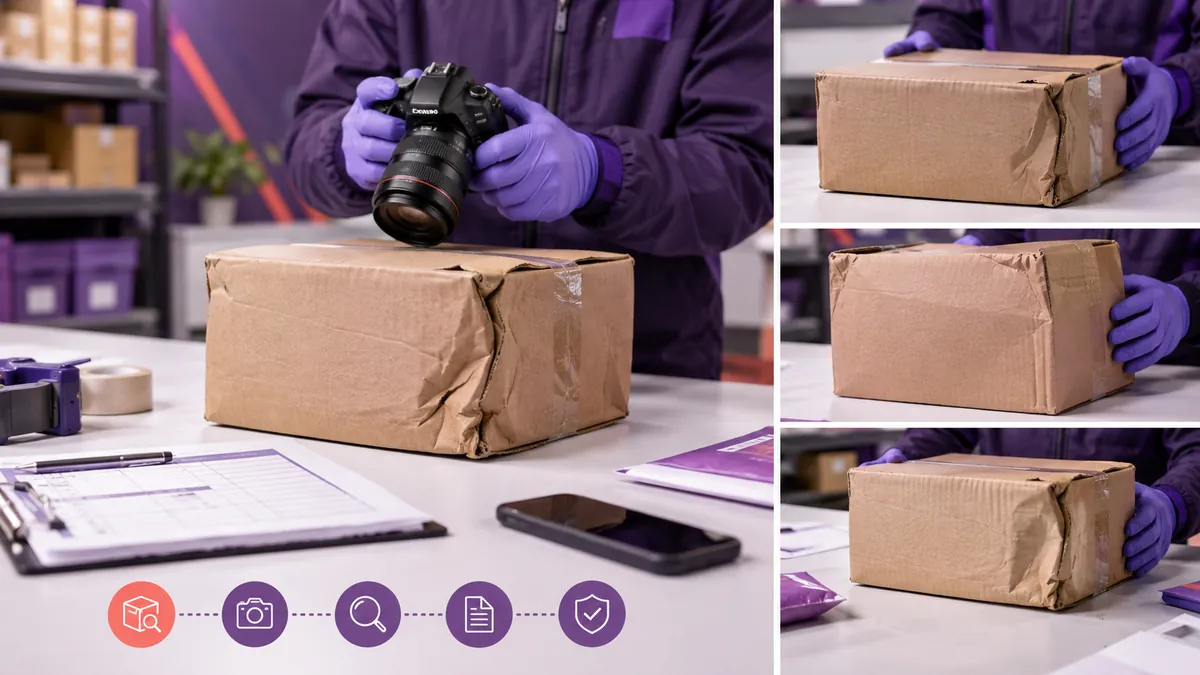
For a damaged delivery, photograph the unopened outer packaging, label and damage points, and record visible damage on the delivery receipt where possible.
Shipping insurance deserves consideration for high-value, fragile, hard-to-reproduce or commercially time-critical consignments.
International delivery time includes collection, export processing, main transport, customs and final mile; it is not simply flight time.
Tracking events show acceptance, transit, customs, delivery and completion stages; not every new scan represents a physical location change.
An international address should include the consignee, company, building and street, city, state or region, postal code, country and a reachable telephone number.
Express services prioritise speed, while economy services focus on lower cost; the right choice depends on product value, deadline and route risk.
Reliable international packaging combines a strong outer carton, product-specific cushioning, secure closure and legible labelling.
Dimensional weight converts the space a parcel occupies into a weight equivalent; pricing uses the higher of actual and dimensional weight.
International shipping rates combine chargeable weight, destination, service level and any applicable surcharges.
There are no published articles in this category yet.
LET’S TAKE THE FIRST STEP TOGETHER